Finite and Non-Finite Verbs: An Introduction
 By S.D. Singh Ratan1 min read
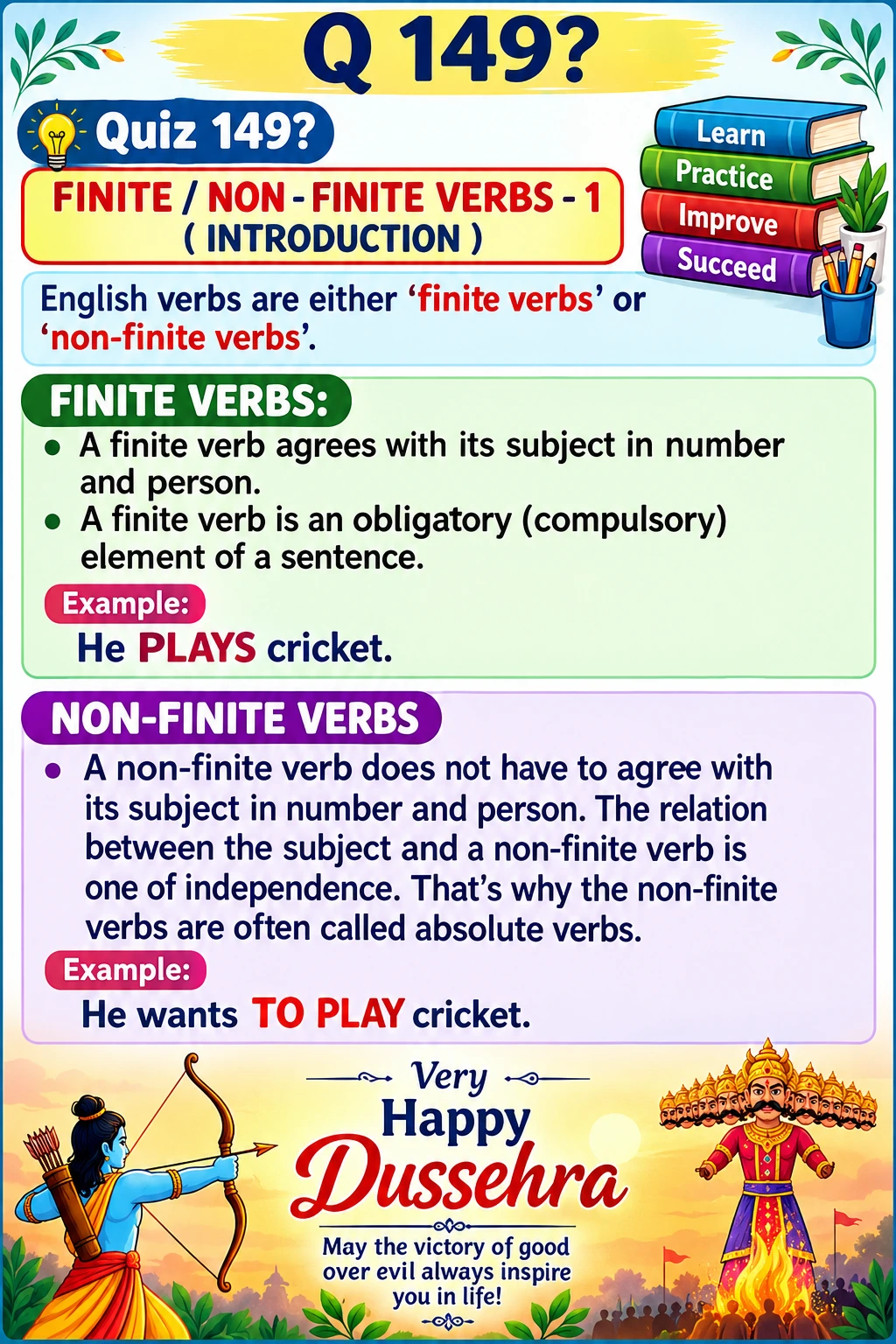
Finite / Non-Finite Verbs – 1 ## Introduction
English verbs are either finite verbs or non-finite verbs.
Finite Verbs
- A finite verb agrees with its subject in number and person.
- A finite verb is an obligatory (compulsory) element of a sentence.
Example:
He PLAYS cricket.
Non-Finite Verbs
A non-finite verb does not have to agree with its subject in number and person. The relation between the subject and a non-finite verb is one of independence. That’s why the non-finite verbs are often called absolute verbs.
Example:
He wants TO PLAY cricket.
The image also includes a “Very Happy Dussehra” greeting: “May the victory of good over evil always inspire you in life!” This is unrelated to the English lesson and has not been included as teaching content. No Hindi meanings or translations are shown in the image.
A LITTLE PRACTICE